"Under the mist of Ponzi is not only the misery and suffering but also the dawn of value..."
The longest Ponzi scheme in history is Bernie Madoff's hedge fund of funds, which lasted for more than 20 years. This kind of long-lasting scam generally does a good job in the following two areas:
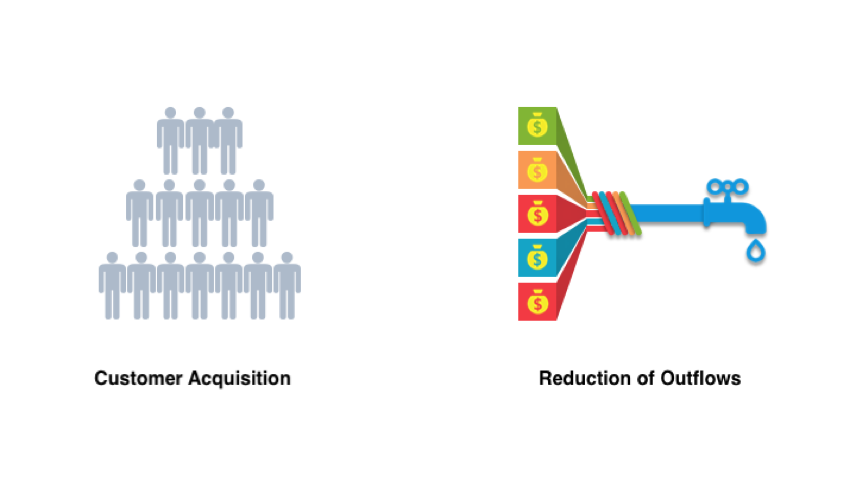
1. Customer Acquisition: keeps the constant flow of funds into a Ponzi scheme;
2. Reduction of Outflows: minimizes the frequency and amount of investors' withdrawal.
Briefly speaking, they can be summarized as broadening the sources of income and reducing outflows.
In fact, the above two features are not exclusive to Ponzi schemes, but to companies, or even economies as well. From the standpoint of the economy, the purpose of the Ponzi scheme is the same as that of the traditional company --- to survive as long as possible.
Ponzi, however, adopts a means of quenching thirst with poison.
01 Broadening the Sources of Income: Customer Acquisition through Traditional Marketing vs. MLM
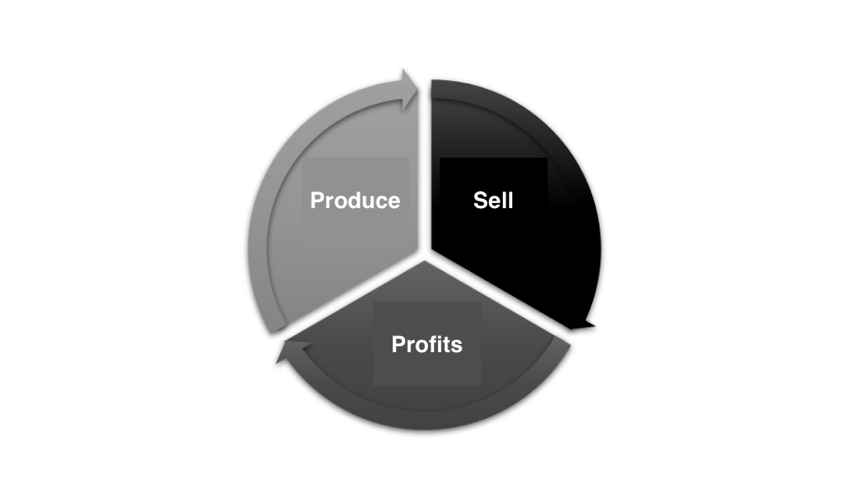
Generally, an economy makes profits by selling the products it produced, thereby promoting its development.
The development model of the Ponzi scheme, however, is different. It involves no effort from the organization (except for those they made to make up a story for MLM), but promotes the progress of the organization through direct promotion and propagation.
Promotion and propagation is a problem put in front of any product in the sales process, and it's also a problem that every enterprise must consider in selling its products.
The Value of Promotion and Propagation
Before getting to the point, let's think about the following question:
For a certain kind of product (physical, Internet or financial), will its value change due to promotion and propagation?
This answer is yes. Promotion will definitely bring value growth.
By analyzing the physical, Internet, and financial products, we can come to the following conclusion:
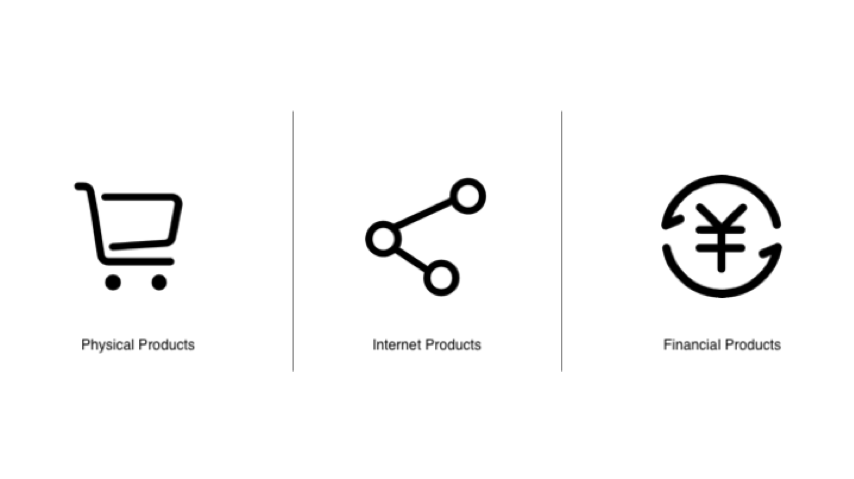
Physical Products
They are relatively constant in value and are less likely to have their value changed due to promotion and dissemination. With the rise of the Internet, however, the value of many physical products is gradually affected by the network effect, which can be best reflected by the standardization of industrial products. The promotion of a product after standardization will bring about more users, which will, in turn, strengthen the standard.
Assuming that the value is largely influenced by customers' demands, the value of the physical product will increase as the number of users increases.
Internet Products
Changes in the value of Internet products can be explained by Metcalfe's Law.
The value of Instant Messaging software, video websites and other products that need to be accessed through the Internet increases with the number of users. Each new user is adding value to the product.
Financial Products
Many financial products also have network effects.
When you need a lending service, you tend to choose a lending platform with more users, so that your funding needs get matched more quickly. This is also true when choosing an exchange. People tend to choose an exchange with better liquidity to meet their trading needs quickly. Better liquidity means more people are trading on the platform, thus the value of the platform increases.
The Bound-to-Crash MLM Model
As the promotion and propagation of any product will increase the value in some ways, some might say that this is exactly the merit of a Ponzi scheme, or more precisely, the MLM (multi-level-marketing) organization. They can get enough financial support through packaging, bragging, releasing high-interest temptations and other aggressive promotional ways.
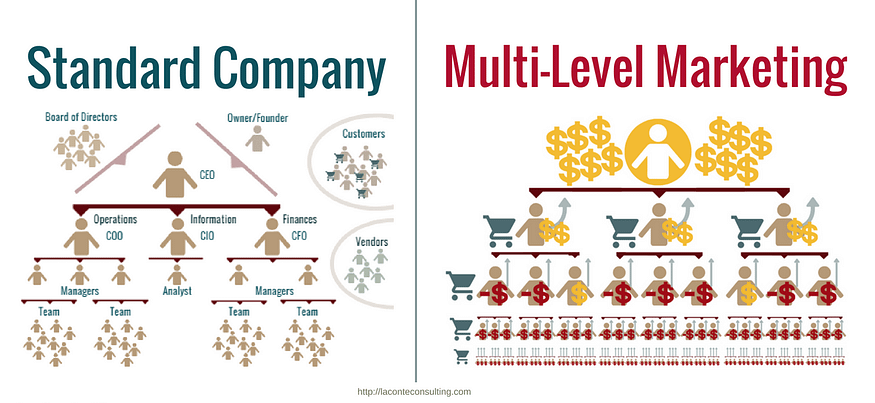
(The Economic Secretariat)
Well, if they could increase their value, why they didn't they last long but instead vanished in the end? That's because of a key factor resulting in the value wearing down over time as described in our previous article "Currency Revolution: Combining Commodities, Securities, and Currency in One: "Super Carrier" Binance Cryptocurrency (BNB), Part 1 & 2". Notably, users of these products will not join if nothing meets their needs.
The Ponzi scheme expands in an aggressive manner.
The increase of value is far from enough to compensate for the value consumed in the future, thus resulting in the inevitable collapse.
Here we can simply simulate it from these two dimensions. The increase in value brought by the expansion is usually illustrated by the formula of the Metcalfe's law.
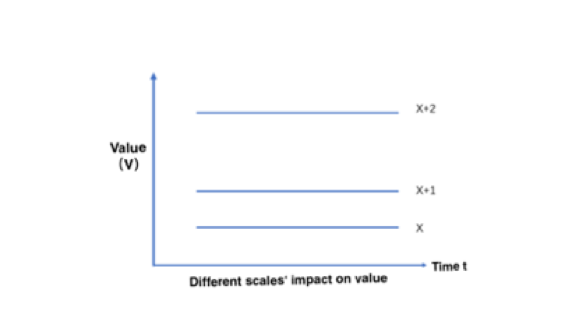
The Scales' Impact on Value
The figure above shows the relationship between value and time at different scales.
In Metcalfe's law, only the relationship between scale and value is considered.
We can see that on the same scale, the change of value over time is fixed. However, when the scale changes from X to X+1, X+2, the value increases in the vertical dimension, which grows non-linearly with the expansion of scale according to the formula of Metcalfe's law as V=CX2.
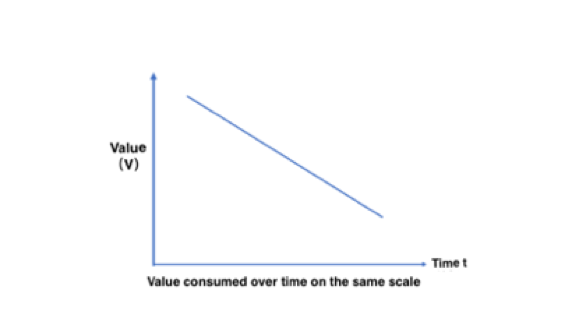
Value Consumed Over Time on the Same Scale
Such consumption is linear, and the rate is proportional to the scale. That is to say, if the number of users is x, then the interest to be paid in the time of ∆t is r1x (r1 is the promised interest rate). Here we did not consider the compound interest and the capital exit. Thus, the value goes down with time.
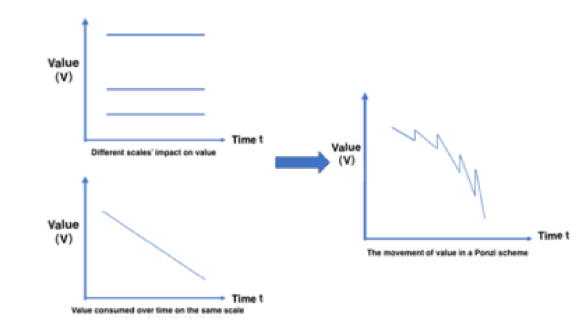
The Movement of Value in a Ponzi Scheme
Putting these all together, you can see that if a Ponzi's scheme scale is not expanded, its value will be consumed in a rate of loss. The expansion of scale will bring a spike in value, and each time the growth of value will exceed that of the previous one. But at the same time, each expansion of scale will also accelerate the consumption of value, and eventually, stop the growth of value.
Therefore, the Ponzi scheme must increase its value every time it is scaled up to slow down the consumption of value. However, for the two major factors affecting the value: there is always a ceiling to the "scale", while "time" can last long, such a scheme must end in a collapse.
The Promotional Models in the Blockchain Industry
In the blockchain industry, there are many projects that halt expansion due to the lack of promotion of value.
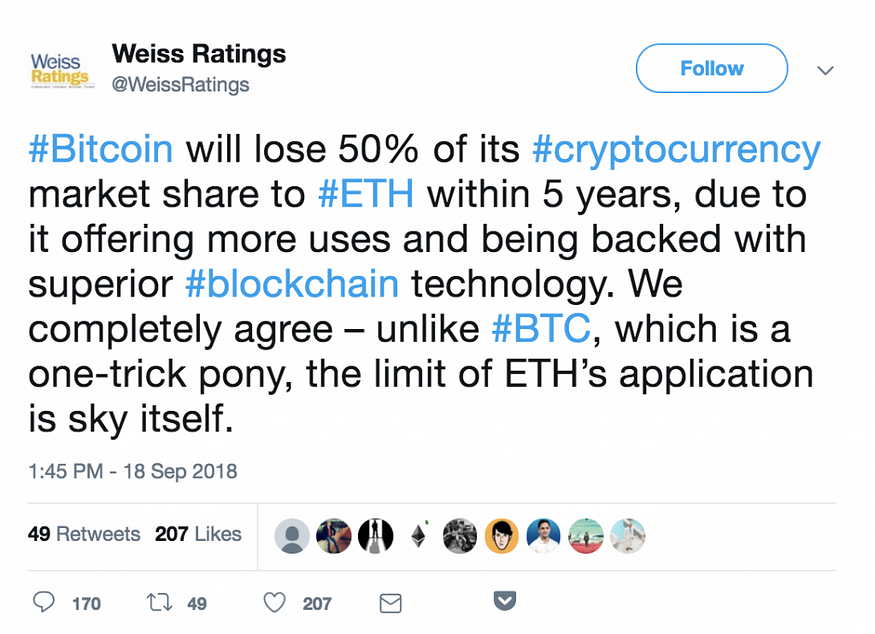
A good project will also require good marketing and publicity. Projects with good quality are forced to close down eventually because the founding team spends most of the time on development without promoting to get funds and survive. Such cases are common not only in the blockchain industry but also among traditional start-ups.
(news.bitcoin)
In contrast, many modelized tokens, or other Ponzi-like projects, basically reveal nothing about the development progress or business practice. The only thing they do is brag about how participants can directly earn huge profits from their projects.
Although more commonly, some projects are not Ponzi schemes but have actual business and development. However, since they are so good at talking big, few will care about the actual implementation that falls behind.
As a result, it overdraws the value of the project, even though it attracts a lot of money.
02 Reducing Outflows: The Carrot-and-Stick Retention Model
The concept of user retention is not unique to Ponzi schemes. Traditional economies have also witnessed a gradual evolution of retention models.
Initially, there were no rules. Then we had some incentives and punishments. For example, regular customers can receive discounts, while premature withdrawal from fixed deposits will lead to the loss of all interests. Additionally, we have some compulsory policies, such as a longer lock-up period for funds redemption.
For traditional economies, poor user retention is like chronic poison, which can gradually corrode their achievements until the end; for a Ponzi scheme, the retention of users (funds) is basically its lifeblood. Once a run happens resulting in the quick loss of users and large sums of funds, the Ponzi scheme will collapse.

(Program-Ace)
Accordingly, we can see that Ponzi schemes with a longer life cycle tend to pay considerable attention to the retention of funds and adopt some incredibly refined management models. To put it simply, they often leverage a carrot-and-stick principle to maximize the retention of user funds. We can understand it better with the case of Baer Chain.
Compulsory Lock-up Policy --- Restrict the Behaviour of Participants

"Super Rich" of Baer Chain
The game of "Super Rich" only offers a one-way channel for ETH, which means that players who buy ETH can only retrieve their money in the form of newly-generated BRCs. Compared with traditional Ponzi schemes, the game does not promise the return of any ETH. All ETHs are coercively locked in the system.
Following "Super Rich", Baer Chain (BRC) launched a new game: Universal City. The intention is to attract players to deposit BRCs for more profits.

(card.shangjieqq)
So, in essence, it asks the players to lock their BRCs earned from the previous game.
Masternodes rewards are similar to all other blockchain projects offering nodes rewards for locking funds in the system.
Consuming BRC = Permanent Lock: Baer Chain also launched a mini-game named Super Soldier, of which the real purpose is to consume BRCs. However, it fails to achieve the expected goal, so the project launched Universal Cities instead. Super Soldier itself can also be seen as advocating the concept of compulsory lock-up policies.

Hayek
Hayek's philosophy is that with control and intervention alone, it's impossible to manage an economy successfully, and the market order must be formed spontaneously in an "inside-out" manner. Scams that retain money coercively with lock-up policies are bound to face high pressure of collapsing at the moment of maturity.
Therefore, it is also necessary to apply some soft policies. If the compulsory policies are to control a person's behavior, the soft policies are to reduce a person's willingness to act, which to some extent can be seen as an issue related to expectation management.
BRC's Soft Policies --- Affect Participants' Willingness
Powerful marketing team --- form a so-called "belief" among participants through pyramid selling strategies.
Price manipulation --- to some extent confirms the "belief" of the participants. By affecting the price of BRC, the team forms a positive feedback cycle, which makes more people believe that the price of BRC will rise steadily. This strengthens their willingness to hold BRCs instead of selling.
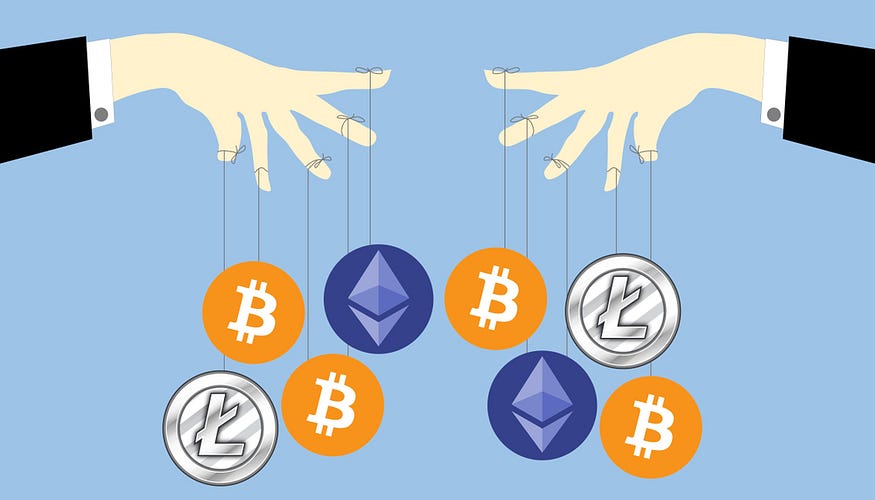
It is worth mentioning that many participants are fully aware of the risks, whether it is in traditional funding, Ponzi schemes or sales of a cryptocurrency. However, giving in to the temptation of high profits, they blindly take part in these events.
For this group of people, brainwashing-style expectation management won't work. The only thing that can change their expectation is the price movement in the secondary market.
Professional players will try to capture the signal of collapse in advance, while the promoter should use the signal in reverse to break the expectations of these players.
However, since the promoters have stronger control in the secondary market, the pricing game can easily become a zero-sum battle.
Expectation Management
Expectation Management is a key element in the financial sector, especially in the secondary market. The one and only goal of all secondary-market participants is to predict the expectation of the counter-party, in order to make the proper moves.
The traditional behaviour of price manipulation can also be outlined as: affect the participants' expectation through price manipulation, in order to pave the way for the next move of the maker.
In the case of Ponzi schemes, the promoters usually know their participants better and can influence their expectation more easily.
Therefore, in the secondary market, what brings you the final success is not your understanding of the market, but your understanding of your counterparty.
03 Conclusion

By scientifically studying the specific operations of Ponzi schemes, we can learn more lessons from them, instead of simply staying away from these scams.
The success of any project is inseparable from proper publicity and promotion. However, when doing promotion, it is important to balance the value enhancement and value loss. Otherwise, unbalanced promotional activities tend to be counterproductive in the long term.
In addition, it is necessary to pay attention to the coercive policies on participants as well as expectation management.
This is the meaning of the design of the token economy.